Best Salt Water Aquarium System Options for Stable Tanks
For saltwater aquariums, maintaining consistent water levels and salinity is essential. A reliable Auto Top Off (ATO) system helps guard against evaporation-driven swings, protecting corals and fish. This article highlights five top ATO options designed for saltwater setups, comparing safety features, sensor design, and ease of use to help readers choose the right system for reef tanks, nano setups, or larger displays.
| Product | Brand | Key Benefit |
|---|---|---|
| Useek Auto Top Off for Saltwater Aquarium | Useek | Real-time protection and compact design |
| Auto Top Off System ATO Saltwater Aquarium (Blue) | ATET | QST Smart Technology for overfill prevention |
| ATO Auto Top Off System for Aquarium (NG ONE) | Miofis | Adaptive learning to reduce pump cycles |
| FZONE Aquarium ATO with Controller | FZONE | QST2.0 real-time safety and dual sensors |
| Auto Top Off System Aquarium – Smart ATO System (Qwakay) | Qwakay | Easy installation with submersible pump |
Below are five prominent options, each offering distinct strengths—whether you prioritize ultra-compact sensors, advanced safety protocols, or adaptive learning. Compare their specs with your tank size, salinity needs, and whether you want a system that works during holidays or travels.
Useek Auto Top Off For Saltwater Aquarium

The Useek ATO is designed to regulate evaporation-driven water loss in both reef and freshwater setups, though it targets saltwater stability. It features a compact design with a nano 0.7-inch diameter sensor, allowing discreet placement in rimmed or rimless tanks. Real-time protection with QST helps prevent overfilling, dry runs, or sensor faults by adjusting fill times and providing visual alerts. This combination supports stable salinity, which is critical for sensitive corals and invertebrates in marine systems.
Auto Top Off System ATO Saltwater Aquarium (Blue)
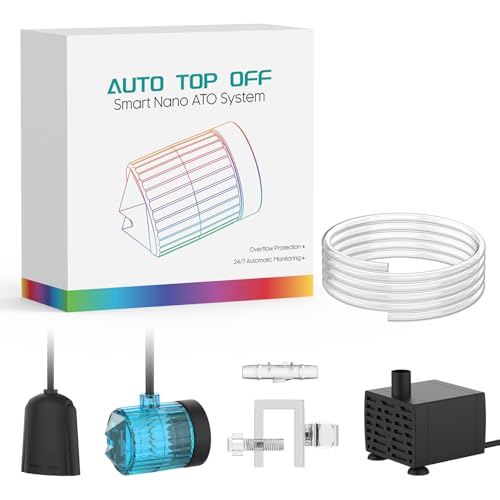
ATET’s ATO system emphasizes real-time water level protection with QST smart technology and dual anti-overflow safeguards. It maintains stabilized water parameters by preventing salinity fluctuations from evaporation. Its ultra-compact optical sensor, at just under one inch, fits neatly into small displays or sumps while offering straightforward installation and reliable operation for reef tanks and mixed aquariums.
ATO Auto Top Off System For Aquarium (NG ONE)

NG ONE introduces adaptive learning to its ATO, analyzing evaporation patterns to reduce pump cycles by up to 60%. The system uses a sealed probe to resist salt creep and debris, ensuring long-term stability in saltwater and freshwater tanks. Triple safety protections include high/low cutoff and anti-siphon design, making it a strong choice for hobbyists seeking both efficiency and enduring performance in reef tanks or mixed Aquariums.
FZONE Aquarium ATO With Controller (QST2.0)

FZONE’s ATO System 2.0 combines dual sensors with advanced QST2.0 safety safeguards. It provides real-time overfill protection, stops the pump if refill events exceed a preset limit, and detects sensor or reservoir issues to reduce risk. The compact optical sensor (0.79 inches) fits smaller displays, while the dual-sensor setup enhances measurement accuracy for fluctuating tanks and wave-prone setups encountered in reef environments.
Qwakay Auto Top Off System Aquarium

Qwakay offers a smart ATO with a compact design and a focus on safety and ease of installation. The system supports aquariums up to 5/8 inch glass and uses a submersible pump for reliable replenishment. It emphasizes user-friendly setup and practical reliability, making it suitable for hobbyists who want a straightforward, effective solution to maintain stable salinity levels in saltwater tanks.
Buying Guide
- Tank size and configuration: Larger displays benefit from ATOs with dual sensors and higher reservoir capacity, while nano tanks prioritize ultra-compact sensors and small footprints.
- Safety features: Look for overfill protection, dry-run prevention, anti-siphon design, and alert systems. Systems with adaptive intelligence can reduce wear on pumps and extend service life.
- Sensor technology: Optical or electronic sensors should be resistant to salt creep. Sealed probes tend to require less maintenance in marine settings.
- Installation and compatibility: Confirm the ATO fits rimmed, rimless, or sump setups, and check reservoir compatibility with your water mixing and top-off workflow.
- Maintenance needs: Some models offer modular components or easy replacement parts; consider long-term costs and ease of sourcing.
- Power and safety: Prefer 12V or low-voltage systems with multi-point safety checks to minimize risk during outages or human error.
- Automation level: Adaptive learning and smart alerts can reduce manual intervention, but may come at a higher upfront cost.
When selecting a saltwater ATO, prioritize reliability, sensor durability in marine environments, and clear safety signaling. The right choice helps maintain stable salinity, consistent water volume, and a healthy habitat for corals and sensitive reef organisms, especially in systems where evaporation rates vary with lighting, temperature, and room conditions.