Best Phytoplankton Food for Corals: Nutritious Picks for Reef Health
For reef aquariums, providing the right phytoplankton-based foods can boost coral coloration, growth, and overall health. This guide compiles top options that deliver diverse blends, appropriate cell sizes, and nutrient profiles suitable for a range of corals and invertebrates. Each product below is designed to support feeding with minimal disruption to tank chemistry, while offering reliable quality for hobbyists and professionals alike.
Summary of chosen products:
| Product | Brand | Form | Key Benefit |
|---|---|---|---|
| Phyto-Feast | Reed Mariculture | Liquid/Phyto-Pigments | High nutrition variety and small particle size |
| Nano Reef-Roids | Polyp Lab | Coral Food | Targeted feeding with off-tank options |
| PhytoChrom | Brightwell Aquatics | Concentrated Phytoplankton Suspension | Multiple phytoplankton types for coloration |
| Ultraplanktos P CWM | Brightwell Aquatics | Liquid Phytoplankton | Temperate water suitability with amino acid blend |
| PhytoGreen S | Brightwell Aquatics | Phytoplankton Suspension | High cell density with coloration support |
Below are five products chosen for diverse phytoplankton compositions, particle sizes, and feeding strategies. Each entry includes a brief product focus, supported features, and practical tips for using it with coral communities.
Phyto-Feast Phytoplankton Food for Corals

Phyto-Feast delivers a diversity of phyto-pigments, lipids, omega-3 fatty acids, amino acids, carbohydrates, and multiple cell sizes, mirroring the natural assortment found in Reef Nutrition’s live version. With a particle size range of 1-15 microns, it easily nourishes a variety of corals and invertebrates. This formulation aims to attract a broader range of tank inhabitants while maximizing nutritional value per feed.
Key use tips: distribute in a controlled manner to avoid excess nutrients and triangulate feeding with your lights and circulation cycle. It is noted for drawing in invertebrates and more challenging corals that may otherwise resist feeding, potentially improving feeding response over time.
Polyp Lab Nano Reef-Roids Coral Food

Nano Reef-Roids from Polyp Lab is a coral food designed to be used when tank circulation is off or dispersed directly to targeted areas. This approach supports localized feeding for corals that extend polyps toward suspended particles. The formula emphasizes ease of use in small or intricate setups where precise delivery enhances uptake by coral tissue.
Considerations: direct feeding can be advantageous for selective corals or during times when water flow would otherwise disperse food too quickly. Monitor for any detritus buildup and adjust feeding frequency accordingly to balance nutrient load with filtration capacity.
PhytoChrom Phytoplankton Suspension

PhytoChrom from Brightwell Aquatics offers a concentrated phytoplankton suspension featuring six types of phytoplankton ranging from 1 to 30 microns. This broad size distribution makes it suitable for many soft corals, clams, sponges, tunicates, and juvenile fish. The suspension is formulated to deliver a dense cell count per milliliter, supporting robust feeding opportunities across a diverse reef community.
Usage guidance: introduce small, frequent doses to maintain consistent nutrient availability without triggering sudden water quality changes. The multi-type approach helps address varying dietary needs among corals and filter-feeders in your system.
Ultraplanktos P CWM Liquid Phytoplankton

Ultraplanktos P CWM is specifically designed for temperate marine aquariums. It includes a proprietary amino acid blend intended to aid coloration in corals and invertebrates. The product is well-suited for cold-water reefs where domestic temperatures and flow patterns may differ from tropical setups, ensuring coral coloration exhibits during appropriate seasons and feeding cycles.
Practical note: maintain careful monitoring of phosphate and nitrate levels when using any liquid phytoplankton to prevent nutrient spikes. Use in moderation and align with weekly testing routines to sustain water quality.
PhytoGreen S Phytoplankton Suspension

PhytoGreen S provides a phytoplankton suspension with cells ideally sized for many soft corals, clams, sponges, tunicates, tube worms, and larval invertebrates. It delivers over one billion phytoplankton cells per milliliter and is supplemented with amino acids to aid coloration in invertebrates. This product emphasizes both quantity and color enhancement potential for a broad spectrum of reef organisms.
Usage tip: combine with targeted feeding for skepticism around digestibility in some species. For best results, pair with a routine weekly schedule that considers tank turnover and grazing activity of herbivorous invertebrates.
OceanMagik Live Phytoplankton
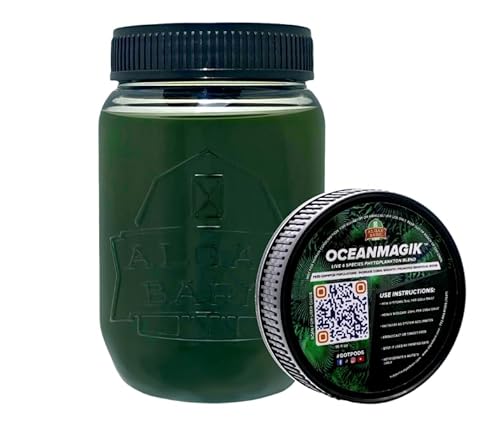
OceanMagik Live Phytoplankton is a tetra blend, combining Nanno, Iso, Thal phyto strains with a fourth component for a broad feed profile. Marketed to support coral, copepod, and filter-feeder health, it is shipped fresh weekly to optimize viability. Users note a sulfurous aroma upon opening, which is typical for live phytoplankton and tends to dissipate after airing out.
Best practices: feed small amounts multiple times per week to sustain high-quality live organisms without causing stagnation or nutrient buildup. Fresh production supports higher uptake by corals and associated fauna, contributing to growth and vitality of the reef system.
Buying Guide: Key Purchase Considerations For Phytoplankton Food
Choosing the right phytoplankton foods hinges on several practical factors. Consider particle size compatibility with your corals, the diversity of phytoplankton types, and how you plan to deliver feed in your tank. Temperature, circulation, and feeding frequency all influence uptake and water quality. Live vs. stabilized suspensions offer different benefits: live cultures can deliver dynamic nutrition and coloration, while stabilized blends reduce variability and storage concerns.
Compatibility with tank inhabitants is essential. Some corals feed best on very small particles, while others prefer a broader range of sizes. Mixed formulations, like PhytoChrom or OceanMagik blends, can support a wider spectrum of species but may require careful dosing to avoid nutrient spikes. Dry or powdered feed is less common for corals but can supplement feeding in very low-flow systems.
Delivery methods vary from direct dispersal in low-flow intervals to targeted dosing with off-tank feeding. For coral-specific feeding, products allowing precise introduction or minimal disturbance to water flow can improve uptake. Monitor water quality regularly after introducing any new phytoplankton product and adjust feeding frequency based on coral growth, coloration, and observed filtration responses.
Storage and shelf-life matter as well. Live phytoplankton needs refrigeration and timely usage, while concentrated suspensions and stabilized blends can be more forgiving. Always follow label instructions for storage, preparation, and dosing. Regular observation of coral coloration and polyp extension can help you gauge whether your current phytoplankton strategy aligns with reef goals.
Finally, consider price-to-nutrition value. Some products claim high cell counts or broad species mixes. Compare feeding efficiency, particle sizes, and the presence of color-enhancing amino acids when selecting a product. A balanced approach—using a couple of complementary feeds—often yields the best overall health and visual appeal for a mixed coral community.