Best Aquarium Heaters for a 125 Gallon Tank: Safe, Efficient Options for Large Setups
Choosing the right heater for a 125-gallon aquarium ensures stable temperatures, protects delicate species, and reduces maintenance. The following select heaters are designed for large tanks, offering safety features like auto shutoff, leaving-water detection, and external digital controls. Each entry includes practical notes on suitability, ease of use, and safety protections to help you compare options quickly for a successful, stress-free setup.
| Product | Brand | Suitable Range (Gallons) | Key Safety & Features |
|---|---|---|---|
| Hygger 1000W Submersible Heater | hygger | 80-220 | Digital LED controller, intelligent leaving-water protection, auto shut off, 59–93°F, ±1°F |
| MantaMaze 800W/1000W Heater | MantaMaze | 20-300 | External digital controller, overheat protection, alarms, two quartz tubes, flame-retardant shell |
| AQQA 1200W Submersible Heater | AQQA | 150-300 | IP68 rating, external thermostat, dual temp displays, auto-restart, safe materials |
| HiTauing 300W/500W Heater | HiTauing | 40-75 | Explosion-proof quartz glass, intelligent out-of-water protection, Fahrenheit/Celsius control |
| HiTauing 500W/700W/1000W Series | HiTauing | 40-125+ | Advanced temp control, out-of-water protection, external digital controller |
Note: For a 125-gallon system, aim for heaters within the 80–220 gallon range or larger; using multiple devices can help maintain uniform warmth and redundancy in case of a failure. The products below are representative options designed to cover a broad temperature range while prioritizing safety and reliability in large-volume tanks.
Hygger 1000W Submersible Heater With Digital Controller

The Hygger 1000W heater is designed for large tanks, including those in the 80–220 gallon range. It features an external digital LED controller with a temperature adjustment range of 59°F–93°F and an accuracy of ±1°F. The controller can be mounted on the tank edge, reducing the need to reach into the water. It includes automatic overheat protection and out-of-water shutoff, with an audible alert and error codes to indicate high or low temperatures. This setup helps stabilize a 125-gallon system without frequent manual checks.
Key considerations include ensuring proper immersion and matching wattage to your tank volume. The long power cord and clear temperature readouts aid in easy maintenance. Potential downsides are the need for careful placement of the external controller and ensuring the heater remains fully submerged to avoid triggering fault indicators.
MantaMaze 800W/1000W Heater For 20-300 Gal

MantaMaze offers robust protection with a dual-layer design: two quartz glass heating tubes and a flame-retardant shell. The external digital controller displays the current water temperature and setpoint, with indicators for high temperature or “out of water.” The system is designed to automatically stop heating if the water level drops or if the top of the heater is exposed. This is advantageous for a 125-gallon tank where water changes or equipment placement can momentarily affect immersion. It is suitable for a broad range of volumes, including large aquariums.
When evaluating, consider the external controller’s readability and ease of mounting. The dual heating elements can distribute heat more evenly, which is beneficial for larger water columns. Users should monitor the controller for false alarms caused by sudden temperature fluctuations in very large setups.
AQQA 1200W Submersible Heater With External Controller
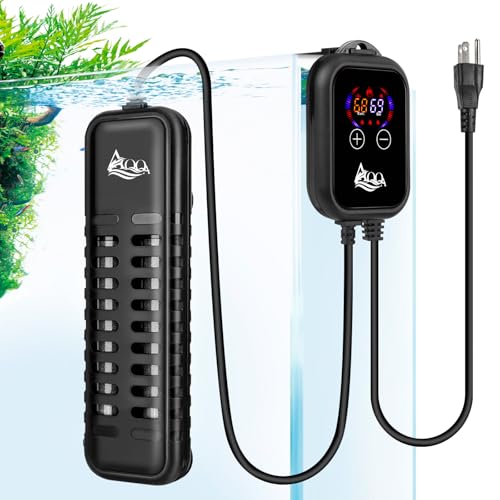
The AQQA 1200W heater is designed for large-volume aquariums, explicitly supporting 150–300 gallons. It includes an external temperature controller with dual temperature displays (current and set temperature) and a temperature range of 59°F–93°F. The unit uses heat-resistant quartz glass with PC plastic housing and an IP68 waterproof rating for enhanced reliability in damp environments. Its auto-restart feature helps maintain consistent temperatures after power interruptions, which is valuable in a 125-gallon system where temperature stability matters for livestock health.
Considerations include ensuring the external controller is easily accessible and that your filtration and circulation promote uniform heat distribution. While the device provides strong protection against overheating and dry-running, regular maintenance of seals and probes will help prevent faults in a large tank.
HiTauing 300W/500W Submersible Heater With Smart Temperature Control

The HiTauing line combines explosion-proof quartz glass with an intelligent water sensor that stops heating if the head rises above water or if the temperature exceeds the set point. The 300W unit is suitable for mid-sized tanks and can scale with larger systems when used in combination with other heaters. The dual-stage control supports Fahrenheit/Celsius, and the long power cord helps with placement flexibility in a 125-gallon setup.
In choosing, consider whether you need a single high-wattage unit or multiple heaters to maintain uniform temperatures. The safety features reduce risk in deep tanks, but ensure that the heater remains fully submerged to avoid triggering E1 or similar fault indicators. Regular checks on temperature readings will help avoid temperature swings.
Hygger 500W Heater For Large Tanks

This Hygger 500W model is designed for mid-to-large aquariums and covers a bracketed temperature range of 59°F–93°F with ±1°F accuracy. It includes overheating and out-of-water protection along with an external LED controller for temperature management. The 10.8-inch heater length helps with discrete installation in taller enclosures, making it a practical option as part of a multi-heater approach for a 125-gallon tank.
Pros include straightforward operation and reliable safety protocols. A potential limitation is that a single 500W heater may be insufficient as a sole heat source for certain 125-gallon setups depending on ambient room temperature; pairing with a second unit or larger wattage device is common for cold rooms or uninsulated installations.
Buying Guide: Key Purchase Considerations For A 125-Gallon Aquarium
- Tank volume and location: A standard 125-gallon setup often benefits from one high-wattage heater or two appropriately matched units to ensure even heating and redundancy. Consider room temperature and whether the stand or canopy affects heat dissipation.
- Wattage and heating range: Choose heaters rated for 80–220 gallons or larger when possible. For extreme climates or heavily planted tanks, a higher wattage model or dual heaters helps maintain stable temperatures.
- Protection features: Look for automatic shutoff when water is low or head is out of water, audible alarms, and error codes. External controllers should clearly display current temperature and setpoint.
- Submersion and materials: Quartz glass and explosion-proof housings protect against breakage and reduce heat loss. IP68 or similar waterproof ratings add reliability in humid environments.
- Control interfaces: External digital controllers reduce the need to reach into the tank. Ensure compatibility with Fahrenheit or Celsius preferences and verify that controls are accessible for quick adjustments.
- Maintenance and monitoring: Regularly inspect seals, probes, and cords. In large tanks, ensure stability of placement and consider having a secondary heater as a backup to avoid temperature swings during a heater failure.
- Energy considerations: Large tanks require substantial energy; balance wattage with energy efficiency, and consider timers or ambient room management to reduce peak demand while maintaining a stable environment for fish and corals.
- Livestock compatibility: Some species are sensitive to temperature fluctuations. Ensure that the chosen heater maintains a consistent set temperature within the appropriate range for your bio-load.
In summary, selecting a heater for a 125-gallon aquarium involves balancing wattage, safety features, and control accessibility. The options listed here emphasize external controllers, automatic protection, and robust construction to support reliable performance in large-volume tanks. When in doubt, consult with local hobbyists or a store’s staff about your specific setup and heating needs to prevent temperature-related stress on your aquatic life.